
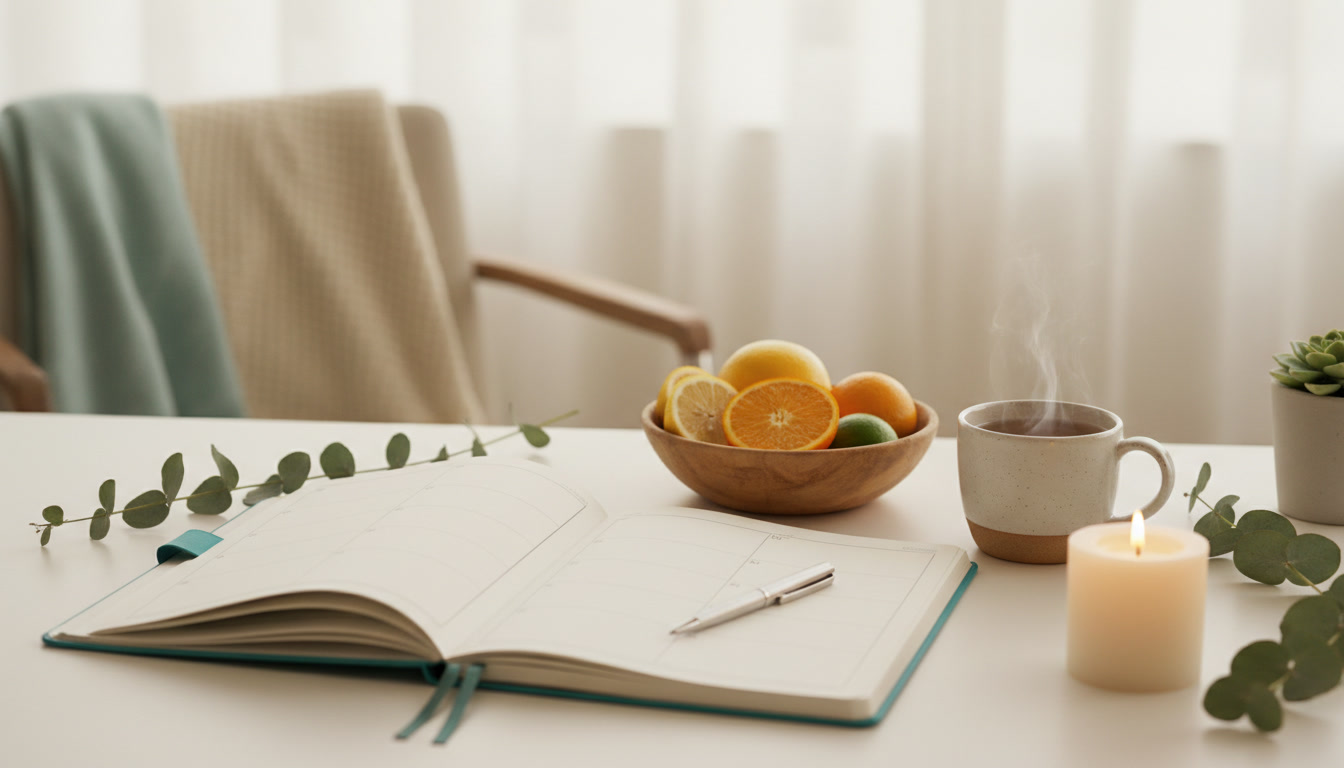
You don’t need a dramatic reinvention to start a new year well. Instead, you need a steady base—one that keeps you grounded when life gets loud, protects your energy when your calendar fills up, and helps you move forward without burning out.
One of the most powerful things you can do is create a calm foundation for the year, so rather than setting “big goals” that spike your nervous system, you can build a calm foundation that makes progress feel safe, repeatable, and real. And honestly? That’s the glow-up. In fact, deciding to create a calm foundation for the year is the first step toward more sustainable change.
What a “Calm Foundation” Actually Means
A calm foundation is not “doing nothing.” Instead, it’s the structure that makes life feel manageable. When you intentionally focus on establishing a calm foundation to create stability for the year, it includes small, simple routines you can repeat even when you’re tired, plus boundaries that reduce unnecessary stress, helping you feel more in control.
Most importantly, it supports your nervous system. When you feel safer in your body, you make better decisions, follow through more often, and recover faster when things go sideways. Additionally, this approach works because it relies on consistency—not intensity. As a result, when you create a calm foundation for the year, you can handle challenges more easily.
For practical proof, incorporating relaxation techniques like progressive muscle relaxation and breathing exercises can significantly reduce stress and tension. Ultimately, the choice to create a year with a calm foundation sets you up for long-term well-being.
Free Download: 30-Min Calm Foundation Reset (Printable PDF)
Instant download — no email needed. Print 30-Min Calm Foundation Reset (free printable)
Your Calm Foundation Blueprint
If you’ve ever started the year motivated… and then felt your energy disappear by week two, you’re not lazy—you’re overloaded. That’s why we’re not building a “new you” with 47 habits and a color-coded life overhaul. Instead, we’re building a calm foundation: a simple structure that holds you steady when your mood dips, your schedule gets messy, or life throws curveballs. This is how you set out to create a calm foundation for the year with intention.
So before you chase goals, you’ll create safety and consistency first. Then, once your nervous system feels less “on alert,” planning stops feeling like pressure and starts feeling like guidance. In other words, we’re making progress feel doable. Let’s walk through the steps. By working to create a calm foundation for the year, you support lasting change.
Step 1: Choose Your “Calm Anchors” (Not 20 New Habits)

First, pick three anchors you can keep on your worst day. Then, let those anchors hold your year steady.
Try this set:
- A 5-minute morning settle (breathing, tea, stretch, prayer, journaling—your vibe)
- A mid-day reset (walk, water, body scan, eyes-off-screen)
- A nighttime wind-down cue (same time, same steps, low light)
Why this works: your brain trusts repetition. Therefore, your anchors become “automatic safety signals,” not another to-do list.
Step 2: Regulate First, Plan Second
If planning makes you spiral, your nervous system is asking for support before strategy. Start with a quick regulator:
- 5 minutes of gentle belly breathing (inhale through the nose, exhale slowly).
- Or try progressive muscle relaxation (tighten and release muscle groups from the toes to the face).
Then, plan from a calmer place. Otherwise, you’ll write goals while your body is screaming “threat,” and you’ll avoid them later.
To support broader stress management, the American Psychological Association APA also shares practical stress-management tips you can incorporate into daily life.
Step 3: Design Your Environment for Calm (Because Willpower Is a Scam)

Next, make calm the default by adjusting your space. Even small changes matter.
Calm environment checklist:
- Keep one surface clear (desk, nightstand, kitchen counter)
- Put a notebook + pen where you’ll actually use it
- Create a “soft landing” spot (chair + blanket + lamp)
- Reduce visual noise (one basket can save your life)
Also, protect your sleep space. A consistent sleep routine and a screen-free buffer can improve sleep quality.
Step 4: Set Gentle Goals That Don’t Trigger Shutdown
Now for goal setting—calm-style. Instead of “I’m going to change my whole life,” try:
- One identity shift: “I’m someone who returns to myself.”
- One skill: emotional regulation, meal planning, budgeting, journaling, walking
- One outcome: more energy, less clutter, steadier mood, more precise focus
Then, convert goals into tiny actions:
- “Write a book” → 200 words, 3x/week
- “Get healthy” → 10-minute walk after lunch
- “Grow my blog” → publish once weekly + repurpose once
Keep your actions measurable and small so you can repeat them.
Step 5: Create a Weekly Rhythm (So You Don’t Live in Reactive Mode)

A calm year usually comes from calm weeks. Try this simple weekly rhythm:
- Monday: gentle planning + top 3 priorities
- Tuesday–Thursday: focused work blocks (short + realistic)
- Friday: life admin + clean-up
- Weekend: rest, reset, and reflect (even 20 minutes counts)
Also, build in “white space.” If your calendar is booked at 100%, your nervous system never gets proof that you’re safe.
Step 6: Set Boundaries That Protect Your Energy
Boundaries aren’t harsh. They’re holy.
Start here:
- Time boundary: “I don’t answer messages after 8 p.m.”
- Work boundary: “I don’t stack heavy tasks back-to-back.”
- Emotional boundary: “I don’t explain myself to people committed to misunderstanding me.”
If that feels hard, begin with one sentence:
“I can’t do that, but I can do this.”
Continue repeating it until it no longer feels wrong.
Step 7: Build a Calm Digital Life

Your nervous system can’t relax if your phone acts like a fire alarm.
So try:
- Turn off non-essential notifications
- Keep social apps off your home screen
- Create a “quiet hour” daily (no feeds, no news, no doom)
- Replace scrolling with a calming substitute (music, stretch, book, journaling)
Even small screen breaks help because they lower stimulus and increase presence.
Step 8: Track Calm, Not Just Productivity
Finally, measure what you actually want more of.
Track:
- Sleep quality
- Mood stability
- Energy levels
- How often did you return to your anchors
- How often you overcommitted (no shame, just data)
This is how you build a year that feels better—not just one that looks impressive.
DIY: The 30-Min Calm Foundation Reset (Printable-Friendly)
Before you plan anything significant, give your body a chance to exhale. This DIY is a short, nervous-system-friendly reset you can do in about 30 minutes to calm your mind, clear the mental clutter, and choose your next steps without pressure. Think of it as laying the foundation first—so your goals don’t sit on top of stress.

Do this once a month, or anytime you feel scattered.
Part A — Regulate (8 minutes)
- Breathing (5 minutes)
- Progressive muscle relaxation (3 minutes)
Part B — Clarify (10 minutes)
Write:
- What feels heavy right now?
- What would make this week feel lighter?
- What is one “minimum version” task I can complete?
Part C — Reset Your Space (7 minutes)
- Clear one surface
- Fill water
- Prep tomorrow’s “first 5 minutes” (pen + notebook, outfit, meds, etc.)
Part D — Choose Your 3 Anchors (5 minutes)
- Morning: _________
- Midday: __________
- Night: ___________
Tiny rule: If you miss a day, restart with the most miniature version the next day. Consistency beats perfection.
Q&A: Calm Foundation

1) What if I can’t stay consistent?
Then your system is overloaded, not broken. Start smaller—2 minutes counts. Also, attach your anchor to something you already do (after brushing teeth, after coffee, after lunch).
2) How do I plan goals without feeling pressure?
Plan actions, not fantasies. Keep goals specific, small, and repeatable, and review weekly. Additionally, write a “gentle fallback plan” for low-energy days.
3) What’s the fastest way to feel calmer today?
Use a breathing exercise for at least 5 minutes, then reduce stimulation (dim lights, silence phone, step outside).
4) How does sleep connect to a calm year?
Sleep affects mood, focus, stress tolerance, and recovery. Keep a consistent schedule and reduce screens before bed when possible.
5) What if my environment isn’t peaceful?
Then create a micro-calm zone: a corner, a chair, a basket of essentials, a lamp—something small that signals safety.
Conclusion: “A Calm Year Is Built in Small Returns”
A calm foundation isn’t a vibe you magically maintain for 365 days straight. It’s a practice you return to—again and again—especially when you don’t feel like it. And honestly, that’s the whole point. You’re not trying to become someone who never struggles. Instead, you’re becoming someone who knows how to come back to center.
So keep it simple: choose your three anchors, plan first, and design your week with breathing room. Then, when you slip (because you will—human behavior), don’t shame yourself or start over with chaos. Just restart with the smallest version of your routine and keep moving.
This is how you create a calm year: not through intensity, but through consistency that feels safe.
Your gentle next step: Pick one anchor you can do in under 5 minutes and do it today. Not perfectly. Just honestly.
If this post felt like a soft exhale, you’ll probably love my companion article, “Why New Year’s Hustle Fails Sensitive Nervous Systems”. It explains why pressure-heavy goals can trigger shutdown, procrastination, and that weird “I can’t even start” feeling—especially if you’re sensitive, burnt out, or carrying a lot. Read it next if you want the missing piece: how to set goals in a way that feels safe enough to actually follow through.
Free Download: 30-Min Calm Foundation Reset (Printable PDF)
Instant download — no email needed. Print 30-Min Calm Foundation Reset (free printable)
“What’s on your heart today? I’d love to hear from you.” a Reply